Petrolia Mural Projects to Begin Taking Shape this Week
Following the results of resident, business owner and visitor surveys and the study completed through the Rural Economic Development Downtown Revitalization Project and our continued work with the Sarnia-Lambton Economic Partnership, and the outlined projects for improvement the committee is moving forward with the final phase of the project.
The three key deliverables were: Retention, Succession and Beautification
Retention – Identifying ways to assist business owners with locating and sustaining business in Petrolia is an ongoing effort that is highlighted by the efforts of the Petrolia Business Association, with support from the Town of Petrolia.
Succession – Succession planning for Petrolia business owners is a key deliverable that will be part of a one-on-one approach to the businesses that have cited this as important for their situation and this outreach has started.
Beautification – As for the beautification deliverable, the Sarnia-Lambton Economic Partnership and the committee held an open call for artists and have selected three mural artists to partner with building owners and Petrolia Business Association in the Town of Petrolia to add to the photo opportunities, walking tours and overall beautification of the Town. The murals will begin to appear throughout Petrolia in the coming days and weeks and will be part of a new Mural Walk promotion for residents and visitors to enjoy.
The first of three murals will begin May 1, 2024, and will be painted in place by Toronto artist Blaze Wiradharma (https://www.blazeworksart.com/ ). This mural will be located on the East side of the Red Apple building on the corner of Petrolia Line and King Street.
One of the following murals will be placed on the side of Leisure Lane, facing East, and will be created by Chatham artist Sarah Steele.
The final mural will be placed on the South wall of Petrolia Home Hardware facing Petrolia Line by artist Sarah Robbins of Windsor, ON.
The murals are the final project to close the grant program. Two of the three murals were funded by the grant program, and the third mural – on the side of Leisure Lane was sponsored by the Petrolia Business Association.
Chairperson of the Petrolia Business Association, Denise Thibeault said, “…Adding to the walkability of a downtown is key to supporting businesses in the area. The more reasons we can provide for people to visit our downtown, the more likely they will spend more time, more money, and discover the unique and friendly businesses in Petrolia.” She added, “We would like to thank the business owners, and building owners for the permission to add these murals to their facades and are excited for everyone to see our murals take shape!”
Residents are invited to visit the mural in progress on the side of The Red Apple this week beginning Wednesday, May 1.
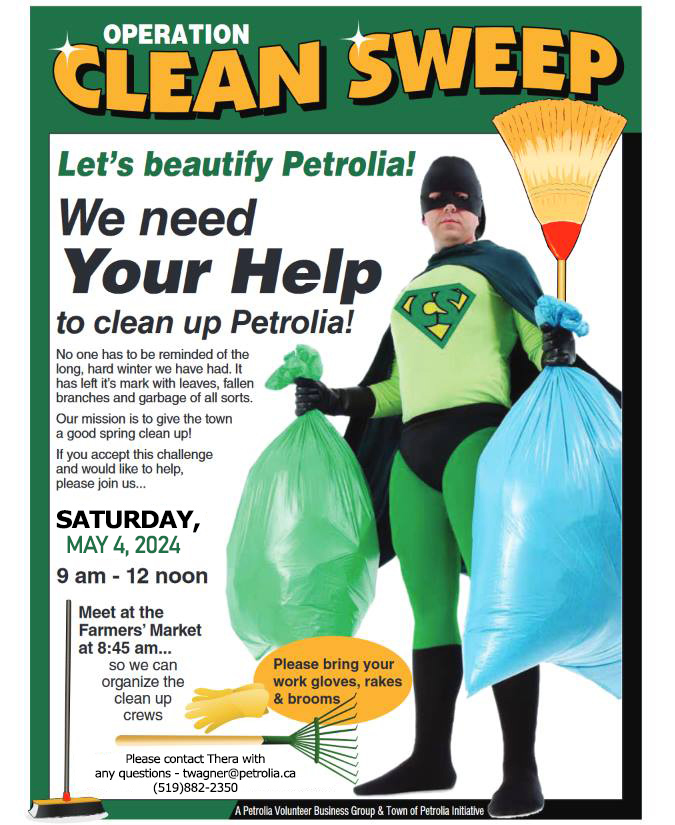
Join Us for the 2024 Day of Action on Litter and Help Clean Up Petrolia!
As the fifth annual Provincial Day of Action on Litter approaches, the Town of Petrolia is encouraging volunteers to come out and participate in a Town Clean Up Day on Saturday, May 4.
The Town of Petrolia will host a downtown and parks clean up day in support of the Provincial initiative. Volunteers are asked to meet at the Kerr Building, 396 Fletcher Street (behind the library) at 8:45 a.m. on Saturday, May 4, 2024. From there, volunteers will be deployed around Petrolia armed with garbage bags, and garden waste bags. Those interested in volunteering are asked to bring gloves, a rake, and a broom.
This initiative has been in place for several years now, and each year a variety of community groups, individuals and organizations participate. Director of Parks, Recreation and Facilities, Julie Bullock said, “It’s always a lot of fun, and the results speak for themselves – in about three hours Petrolia is cleaned up, litter is collected and we’re ready for another season of enjoying our parks and outdoor spaces.” Student volunteers can earn high school volunteer hours by bringing their sheets to be signed by Town staff.
There is no need to pre-register, but if you would like to request a certain area of Petrolia to help with, please contact Thera at twagner@petrolia.ca. This event will not proceed in rain, an alternative date will be announced if required.
2024 GREEN LEADER PROGRAM Recipient Announcement
In partnership with Waste Management of Canada and the Town of Petrolia
April 22, 2024
The Green Leader Program is part of Waste Management and the Town of
Petrolia’s ongoing efforts to encourage the development of local community
engagement and environmental solutions that build sustainable communities. The program
is centered around a grant opportunity that is available to applicants living,
working, and learning in the Town of Petrolia or benefiting Petrolia and its
residents.
Waste Management and the Town of Petrolia are pleased with the number of businesses, organizations, and institutions that applied for this funding opportunity in the 2024 intake. The program is designed to support initiatives that highlight the following sustainability goals:
Environmental Goal:
- The Green Leader program supports organizations and initiatives that preserve and/or enhance natural resources and/or help reduce greenhouse gas emissions.
Community Goal:
- The Green Leader program focuses on local initiatives that support employees, enhance our environment, promote education, and improve the safety and livability of our communities.
Each year, a committee of community members look over the applications and grade each application on the above criteria and rank the applications with assigned dollar value recommendations. There is an available funding amount of $15,000 available for the projects. Each applicant may request up to $15,000 in program/project funding. This funding is a one-time, non-repayable, fully funded grant. Applications are due each year on March 30. Waste Management and the Town of Petrolia would like to thank our volunteers for their assistance in the selection of this year’s recipients.
“Earth Day is the perfect day for this annual announcement as it brings community attention to the issues facing the earth and through this program, it is a nice opportunity to do our part. Residents are encouraged to visit earthday.org to learn more about what they can do for our planet. We are very grateful for this partnership with Waste Management for the betterment of our community and for our earth.” Said, Chief Administrative Officer/Treasurer Rick Charlebois.
2024 Successful Projects:
KIWANIS CLUB OF PETROLIA AND AREA – EXPANSION OF PRESCHOOL GARDENING PROJECT
$1,000
Enhancement to the 2021 project includes adding AeroGardens to 5 programs, and supply seed kits for all eleven AeroGardens and adding a rain barrel for pre-school and school-aged children.
PETROLIA 150 – BAND SHELL LED LIGHTING, LOW-FLOW WASHROOM FIXTURES, MOTION LIGHTING
$7,000
The addition of low-flow washroom features, motion-activated faucets, LED lighting and motion-activated lighting to reduce energy consumption and water use.
PETROLIA DISCOVERY – NORTH PERIMITER HEDGEROW
$3,000
The goal is to establish a hedgerow using a mix of native trees and shrubs. Once established, the hedgerow will serve as a low maintenance, visually appealing living “fence” while supporting local wildlife, reducing soil erosion, and reducing surface water runoff.
GENERATIONS DAYCARE – MULTI-GENERATIONAL NATURE GARDEN
$1,000
The addition of a garden to conserve butterflies and native insects. The students will help with the planting and weeding and will learn all about the materials used. The garden will be located by the front door, and will be for students, parents, and community members to enjoy.
PETROLIA 150 – INDIGENOUS FRIENDSHIP GARDEN
$3,000
The addition of an indigenous friendship garden in Victoria Park next to the band shell featuring orange plants and flowers with a central stone featuring a land recognition message.
Previous Successful Applicants:
2023
Lambton Central Petrolia Optimist Club – Kerr Park Project – $3,000
Petrolia & Area Kiwanis Club – Expansion of Preschool Gardening Project – $4,000
Queen Elizabeth II School – Queen E Goes Green – $5,000
St. Philip Catholic School – Native Species Welcome Gardens – $3,000
2022
Hillcrest Public School (School Council) – $5,000
The Rotary Club of Petrolia – $5,000
Petrolia Heritage Advisory Committee – Special North Street Cemetery Project – $2,500
IODE Margaret Stokes Chapter – $2,500
2021
The Petrolia Discovery Foundation Inc. – approved for – $10,000
The Petrolia and Area Kiwanis Club – approved for – $5000
2020
Parents For-Parks – approved for – $15,000
St. Clair Conservation Authority – approved for – $10,000
The Petrolia and Enniskillen Agricultural Society– approved for – $5,000
(2020 was a double intake year)
As part of the Town of Petrolia planned proactive by-law enforcement, the County of Lambton will be conducting proactive enforcement regarding the Tidy Yard By-Law as the next step in this approach in the coming days. By-Law Enforcement can be reached at (519)845-5420, and as always our comment forms can be found at https://town.petrolia.on.ca/…/citizen-engagement…/
Here is the by-law for your review: https://town.petrolia.on.ca/…/01/41-2019-Tidy-Yard.pdf

Petrolia Pizzafest returns to Victoria Park, Petrolia on June 1, 2024, the 11th annual pizza-lovers event will be a celebration of the cheesiest event the town has to offer.
Petrolia is not short on pizza restaurants looking to fill hungry bellies, and event organizers are pleased to boast 7 participants for 2024 – Bud’s Family Pizza; Dominos Pizza, Petrolia; Godfathers Pizza; Johnny G’s Premium Pizza; Petrolia Pizza & Subs; Pizza Hut, Petrolia; and Wise Guys Inc.
Known for the pizza, this event packs a whole lot of fun in to one day. For kids – bouncy castles, and games! For families, pizza, a Service Club BBQ and food truck, cold non-alcoholic drinks, and Petrolia Scouting offering freezies and ice cream! Our Petrolia 150 Committee will even have a surprise or two!
The day is packed with live entertainment starting at noon with The Fischer Lovatt Duo, followed by BREN (an incredible one-man band!), Speed Wobble and then closing the evening – Full Disclosure Band! There is even a beer garden for those that can’t resist the famous combination of pizza and cold beer!
The event has been generously sponsored by Bourque Renovations, Rick and Barb Charlebois, Albany Retirement Village, Baysar Business Solutions, and Holland Cleaning Supplies.
“We’re looking forward to our eleventh Pizzafest this year! Pizza in a park with live music, what’s better than that?!” Said Julie Bullock, Director of Parks, Recreation and Facilities. She added that, “This is a great opportunity for families to gather in Victoria Park and enjoy some pizza and some fun and games too!”
The participating pizza restaurants are facing increased expenses but have chosen to hold the pizza ticket price at $2.50 for the event citing that they “…Want to keep the price affordable for families to enjoy a day in the park.”
The event runs from noon until 7:00 p.m. on Saturday, June 1, 2024, in Victoria Park, Petrolia.
“These events are not possible without a tremendous team of volunteers, we are so grateful to the Community Services Advisory Committee, our Service Clubs, businesses and our community members that step-up year after year to support our community events and activities.” Said Thera Wagner, Marketing and Special Events Associate.

As part of the Town of Petrolia planned proactive by-law enforcement, the County of Lambton will be conducting proactive enforcement regarding parking violations and derelict vehicles as a first step in this approach in the coming days. Parking By-Law Enforcement can be reached at (519)845-5420, and as always our comment forms can be found at https://town.petrolia.on.ca/…/citizen-engagement…/

The Petrolia 150 Committee is pleased to announce a project in partnership with another Petrolia business in celebration of the Town’s 150th anniversary of incorporation.
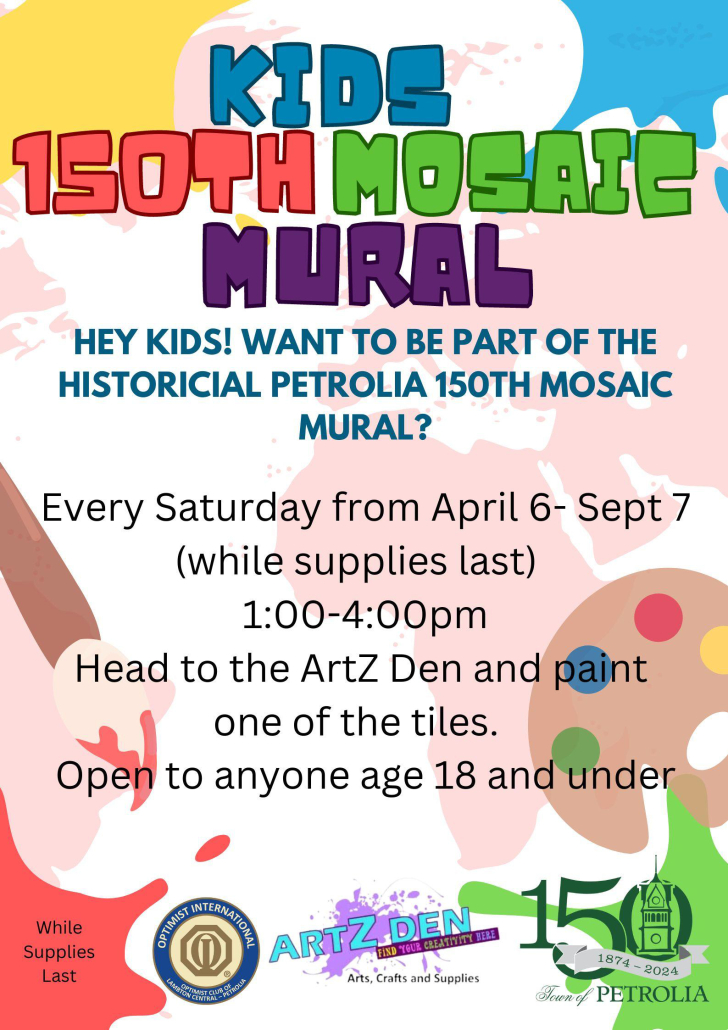
A Mosaic Mural project starts this Saturday at The ArtZ Den in Petrolia.
With support from The ArtZ Den and sponsorship from the Lambton Central Petrolia Optimist Club, children up to age 18 can drop in to The ArtZ Den at 4207 Petrolia Line and paint a part of the mural project that is 3.5” square on Saturdays from April 6 through September 7, 2024, between 1:00 p.m. and 4:00 p.m. while supplies last. No registration is required, all supplies are provided.
“…The idea is that our young people paint pieces of the mosaic mural with scenes that remind them of Petrolia. It could be a place, a park, an event, or a sports memory. All creative ideas are welcome. The mosaic will then be glazed and put together and be placed beside the Petrolia 150th incorporation as a village mural (placed in 2016), on the side of the Victoria Playhouse Rehearsal Hall, facing the main entrance of Victoria Hall.” Said Petrolia 150 Committee Member, and Lambton Central Petrolia Optimist Member: Deb Kohoutek.
Denise Thibeault, Chairperson of the Petrolia 150 Committee said, “The committee would like to extend our gratitude for the community partnerships that are making this project a reality, from the space and materials, the paint, and brushes and to the cutting and preparation of the small, paintable squares of wood. We look forward to another piece of the 150 celebrations coming together and can’t wait to see what our young people come up with!”
White and Green Flower Theme in Petrolia Announced for 2024
Petrolia will be full of many vibrant blooms once again this summer, as the Petrolia in Bloom Committee is planning and planting white and green flowers for the 2024 season.
This colour choice is in honour of the Town’s 150th anniversary of incorporation, a party that extends through the entire year in Petrolia.
In the spring, gardeners will begin to plan their planting beds for the season and residents are encouraged to participate in the colour palette and to have some fun.
Mayor R. Brad Loosley said, “It is with great appreciation to our volunteers that I look forward to our town full of beautiful plants and flowers each year!”
Volunteers interested in helping for the 2024 season are asked to call Leah Belan at (519) 882-2350. Parks Department summer students will assist the volunteers with watering and weed maintenance.

VICTORIA PLAYHOUSE PETROLIA CAPITAL CAMPAIGN KICKS OFF WITH GENEROUS DONATION FROM
THE MARGARET STOKES IODE
Petrolia, ON – In celebration of their 75th Anniversary in Petrolia, the Margaret Stokes IODE has generously donated $25,000, marking the official launch of the Victoria Playhouse Petrolia’s capital campaign.
Announced late last year, the VPP’s capital campaign will raise funds to improve Victoria Hall’s accessibility. Director of Marketing, Arts and Communications for the Town of Petrolia, Laurissa Ellsworth, explained “We’re looking to add what we would consider a tower addition on the back, north side of the building, that would take an elevator from the lobby level all the way to the balcony and add about ten washrooms in the process, a few on each floor.”
During a cheque presentation at Victoria Hall this morning, VPP Co-Artistic Director David Hogan was joined by past and current Margaret Stokes IODE Presidents Wendy Loosley and Dawn McNally, Mayor of the Town of Petrolia R. Brad Loosley, and the Town of Petrolia’s CAO/Treasurer Rick Charlebois. His excitement was palpable as he thanked the IODE saying, “Seeing these plans finally coming to fruition is so exciting. The enhancements to Victoria Hall will make it more accessible to all theatre patrons and the VPP team is deeply grateful to the Margaret Stokes IODE for this generous gift propelling us closer to our goal.”
The VPP Capital Campaign aims to raise $3.5 million, with an aim to begin the project in 2025.
Founded in 1900, IODE Canada is a national women’s charitable organization dedicated to enhancing the quality of life for individuals through education support, community service, and citizenship programs. IODE Margaret Stokes Chapter, a branch of the National Chapter, received its charter in March, 1949, in Petrolia, Ontario
The Victoria Playhouse Petrolia’s 2024 Season – A Rush of Excitement! begins May 7 and runs through October 27 with six stellar productions hitting the stage. Celebrating Petrolia’s 150th birthday, Oil Rush– The Big Discovery Musical runs May 7-26. The highly anticipated tribute to Gordon Lightfoot, Rainy Day People hits the stage June 4-23. Celebrating Sweet Soul Music from July 2-28 patrons can expect a world-class musical experience. The poignant play, Tuesdays with Morrie, starring Keith Savage and Michael Vanhevel runs August 6-18. Jesse Grandmont and his gang of wildly talented friends are back for The Ultimate Fiddler on the Loose from September 10-29. The season wraps up with a beautiful theatrical concert, The Tony Bennett Songbook, on stage October 8-27.
Starbright Christmas 2024 will run November 20-December 8 and The VPP Holiday Jamboree will run December 13-15. Stay tuned for further casting announcements to come!
Tickets are on sale now with subscriptions, group rates and single tickets available. To purchase, visit www.thevpp.ca or call the Box Office at 1-800-717-7694. Performances run Tuesday through Sunday with both matinee and evening options available.
MEDIA CONTACT: Callandra Dendias, VPP Program Coordinator
cdendias@petrolia.ca 519-476-1174
Left to Right: R. Brad Loosley, Mayor; Rick Charlebois, Chief Administrative Officer, Treasurer; David Hogan, Co-Artistic Director, Victoria Playhouse Petrolia; Dawn McNally, President, Margaret Stokes IODE; Wendy Loosley, Past President, Margaret Stokes IODE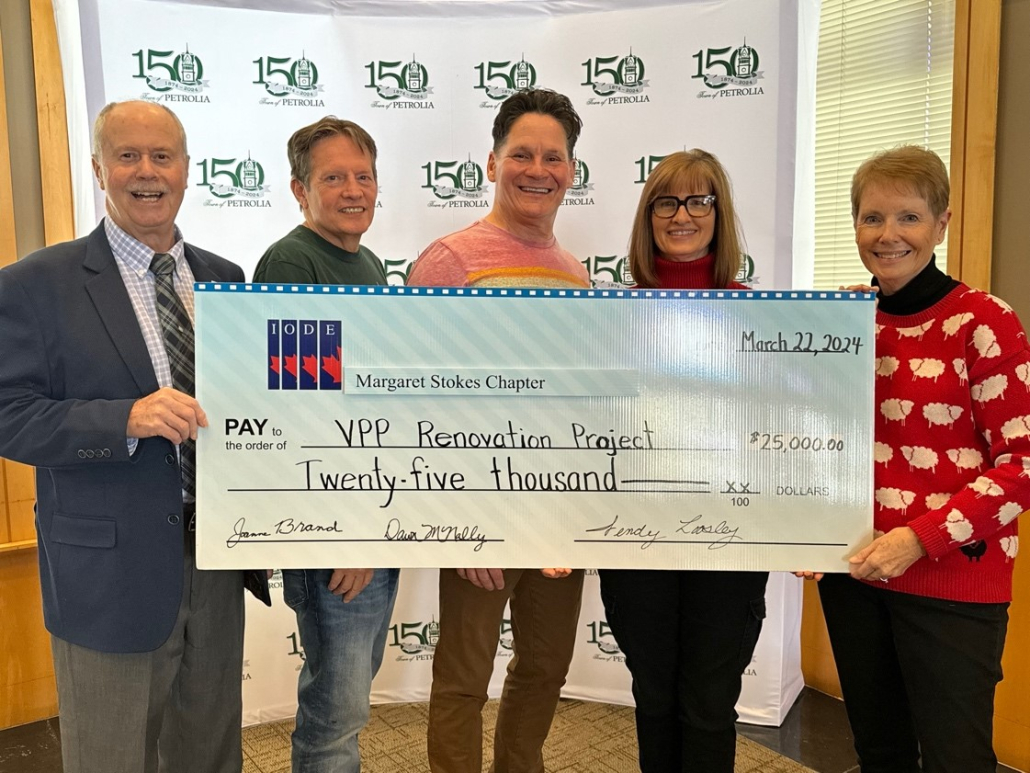

PETROLIA YMCA

FARMER’S MARKET

VICTORIA PLAYHOUSE

COMMUNITY FUND

CONTACT US
411 Greenfield Street, Petrolia, ON N0N 1R0 | TEL: (519)882-2350 | petrolia@petrolia.ca
The Corporation of the Town of Petrolia 2016 | PRIVACY POLICY
Powered by Website Design